
Rising stressed debt and past exposures like Reliance Capital, Yes Bank push EPFO to frame exit rules for its portfolio.
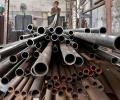
The Indian steel industry is faced with a paradox: Rising demand and falling prices. Demand continues to surge as user industries gather pace, with the World Steel Association projecting around 9 per cent annual growth for India over 2025 and 2026, the year domestic demand is projected to be almost 75 million tonnes (mt) higher than in 2020.
Ahead of the key meeting called by the steel ministry with the industry captains on Monday to discuss the impact of rising steel imports, companies have raised the issue of cheaper 'substandard' inflows from China, Vietnam, and South Korea, saying they are setting the benchmark for domestic prices and squeezing the profitability of Indian producers.

The imposition of a 100 per cent tariff by the US on imports of branded and patented pharmaceutical products starting October 1 may not significantly hurt Indian drug makers, with Sun Pharma being exposed to some headline risk but with limited earnings impact, according to analysts. Among Indian companies, only Sun Pharma has sizeable sales from patented drugs in the US (about 17 per cent of 2024-25 revenue), HSBC Global Investment Research said in a report.

The Indian IT services sector is staring at a second consecutive year of muted revenue growth due to modest increase in tech spends in Europe and the US, a domestic rating agency said on Wednesday. Crisil Ratings said it expects the sector to grow at 5-7 per cent in FY25, after a growth of 6 per cent estimated to have been achieved in FY24. The overall industry size is pegged at $250 billion and it creates over 50 lakh direct jobs.

Experts say Indian Railways must grow its share in the freight market to remain financially sustainable.

The move is to align affordable housing finance flows to the increase in property costs and inflation, says Raghu Mohan.

Domestic steel prices have seen an increase over the past couple of months in anticipation of a safeguard duty, but a looming global trade war is likely to weigh as threat of import rises and prospect of export flounders. Data from BigMint showed that in March 2025, hot rolled coil (HRC) prices ex-Mumbai increased by Rs 600 per tonne month-on-month (M-o-M), rising from Rs 48,400 per tonne in February to Rs 49,000 per tonne.

Mining conglomerate Vedanta Limited has received approvals from the majority of its creditors for a proposed demerger of businesses, marking an important step in the company's plan to split into six independent listed companies. "I am happy to let all of you know that we have received the 52 per cent plus the additional percentage, which is required for us to reach 75 per cent. "We have crossed that threshold as well. Most of the lenders have approved it," a senior Vedanta executive said in a recent bondholder conference call.

Brent crude oil price surged 4 per cent on Friday, following tension between Iran and the US. Airlines, however, have been unable to pass on the price increase to customers due to the soft demand.

During 2023, the Indian real estate sector - both housing and commercial - witnessed buoyancy fuelled by demand, supply, and absorption, and the sector is banking on the upcoming Budget to keep the momentum going. Mumbai-based Sattva Group wants the government to focus on the critical pillars for long-term growth. The company emphasised on the infrastructure boom with increased allocation, lower goods and services tax (GST) rates, incentives for affordable housing and single-window clearance to fast-track projects and support liquidity.

Any government support or incentive to help exporters deal with high freight and insurance costs is unlikely.

Tyre stocks have been on a tear over the past six months, with average returns exceeding 45 per cent. Except for Apollo Tyres, which has seen a slight correction in the last month and a half, limiting its gains to 16 per cent, listed peers such as MRF, CEAT Tyres (formerly Cavi Elettrici e Affini Torino), and JK Tyre & Industries have delivered returns exceeding 30 per cent during this period. Production-related constraints and sluggish demand in Europe, where sales are expected to remain flat, coupled with high valuations, have contributed to Apollo Tyres' underperformance. The tyre sector's gains can be attributed to robust growth trends driven by the replacement market, which constitutes more than two-thirds of sales.

'Interim Budget has ignited the entrepreneurial spirit.'
Vedanta group chairman, Anil Agarwal, 69, is well known for his business journey from a scrap dealer from Bihar to a London-based globe-girdling metal and oil and gas conglomerate with revenues of $19 billion. Now his abilities to keep his group from over-leveraging itself will be put to the test. Over the years, Agarwal, now based in London, set up the conglomerate via acquiring iron ore producer Sesa Goa, Cairn's oil producing assets in India, and Electrosteel Steel.

Less-than-expected rainfall and a poor spatial distribution, experts say, can rekindle fears of a rise in food and fuel inflation that can have an impact on the RBI's monetary policy. The fear of less than optimal rainfall due to El Nino this year, analysts believe, is the biggest short-term risk for the markets, which they said has not been fully priced in yet by them. Monsoon set over Kerala on June 08, a week later than its scheduled date.

Shares of companies having investments of late billionaire investor Rakesh Jhunjhunwala ended on a mixed note on Tuesday. The 62-year-old investor, who was known as the Big Bull and Warren Buffett of India for his investment acumen, passed away on Sunday. Jhunjhunwala had investments in more than three dozen companies, the most valuable being watch and jewellery maker Titan, part of the Tata group. Titan ended 0.88 pe cent higher at Rs 2,493.65.

A depreciating rupee, which briefly hit 80 to the dollar on Tuesday, may boost India's exports but price-inelastic imports of crude oil and gold would mean limited relief on the trade deficit, which clocked a record $26.2 billion in June. Due to global risk aversion on the back of geo-political tensions and aggressive policy tightening by the Fed, the dollar has appreciated against most currencies, including the rupee. And, with other currencies depreciating, India's comparative advantage in this respect may be limited.

The industry's operating margins will narrow by 0.30- 0.80 per cent largely on an increase in local hires which the industry has been forced into due to the policy framework in its markets.

Stating that COVID-19 has not yet been contained in India, the rating agency in a statement said the government stimulus package is low relative to countries with similar economic impacts from the pandemic. "The COVID-19 outbreak in India and two months of lockdown -- longer in some areas -- have led to a sudden stop in the economy. That means growth will contract sharply this fiscal year (April 2020 to March 2021)," it said. "Economic activity will face ongoing disruption over the next year as the country transitions to a post-COVID-19 world."

The dreary, cold months from December to February may prove to be the undoing of many a nation as they grapple with sky-high fuel prices - a result of the Ukraine conflict and the pandemic. Many - Europe, South Korea, Japan, and China - will still pull through on the strength of their wealth or because of strong storage infrastructure. But India will have its back to the wall. Signs of liquefied natural gas (LNG) rates hitting new records this winter are already evident.

For 2021-22, it projected the economy to clock a growth of 10.6 per cent.

Domestic factors are a bigger constraint for India's shift to a faster growth trajectory than the global factors, CRISIL's chief economist says.

Top Indian IT firms, such as TCS, Infosys, and Wipro, have signalled taking aggressive cost take-out measures, including reduction in sub-contracting costs, travel expenses, freeze in salary hikes, and holding back variable payments, among others.

...followed by financial services, IT, and sales and marketing.
The major beneficiaries of loan recasting will be sub-Rs 500 crore corporate exposures and retail exposures, which were earlier expected to see the highest increase in NPAs in percentage terms.

On November 12, 2021, the Reserve Bank of India (RBI) decided to ring in uniformity in asset classification and income recognition across all lending institutions. Shadow banks, or non-banking financial companies (NBFCs), like commercial banks, are to test non-performing assets (NPAs) on a daily basis and upgrade them to "standard assets" only when interest and principal arrears are settled by borrowers. This is going to create all manner of headaches for shadow banks and their clientele. Says Y S Chakravarti, managing director and chief executive officer (CEO), Shriram City Union Finance: "NPA levels will go up, especially of small borrowers.

After a stint in Crisil as chairman, Mohan joined the Mukesh Ambani-led company as executive director in August this year, RIL spokesperson said.

The regulator is more carefully scrutinising applications by infrastructure investment vehicles that have a limited number of investors. They have been asked to broaden their investor base before application approval, according to two people familiar with the matter. The Securities and Exchange Board of India is concerned about the structure being used for getting around tax requirements, according to one of the sources.

Russia's war on Ukraine has sent steel prices soaring to its highest levels in the domestic market since November 2021. But there is little cheer in the industry. That's because input costs are spiralling out of control, leaving the big boys nearly as high and dry as the small, medium and secondary steel producers. Russia and Ukraine are major providers of steel and raw materials to the world.

South leads; North-East at bottom but moves ahead, finds out the IndiaSpend Team

India must be prepared for a big, fat fuel import bill in FY23 - barring any further avatars of the Covid virus - as refiners crank up runs, or crude processing rates, to meet the growing demand for fuels, and crude prices soar. Capacity additions by an Indian state-run refiner will reinforce the need for foreign crude. Demand for all fuels is expected to increase by 3-8 per cent next fiscal from 2021-22, reaching pre-pandemic levels, according to analysts and industry experts.

Direct economic stimulus measures such as tax cuts for individuals and industry would have helped to prop up the Indian economy which was hit hard by the lockdowns across several states in India, say economists and corporate leaders. While the measures announced on Monday are focussed more on the supply side, these steps would take a lot of time to move the needle for the economy.

The government kept its nerve in the face of a massive shock. It chose not to resort to a massive fiscal stimulus. It focused instead on providing liquidity support and easing restrictions on movement in stages, observes T T Ram Mohan.

Bharti Airtel called the prices exorbitant while Vodafone Idea wants the auctions take place in 2020. The auctions need to happen when the infrastructure is ready for the roll out, be it in terms of fiberisation levels, or optimisation of equipment and software etc. Spending a hefty amount on a technology (airwaves) that at present offers limited returns is not going to be a priority for the incumbent telcos.

Most analysts expect growth in the sales of Nifty-50 companies to decelerate, albeit marginally, in the quarter ended December compared to the corresponding period of 2013-14, with metals and real estate companies pulling down earnings.

Indian auto industry's dependence on China is high and it will continue to be so in the BS-VI era and as the country moves towards electric mobility. Domestic players lack both technological competence and the sheer pricing advantage that support Chinese imports.


The proposed annual quota for Indian companies could be between 10 and 15 per cent. Currently, there are no country-specific limits on H-1B allotment.

The national carrier, which is already struggling with its fuel payments, spends Rs 6,000-7,000 crore annually on fuel. A 10 per cent hike in crude price would mean over Rs 50-58 crore of extra costs for the airline.
 © 2026 Rediff.com - Advertise with us - Disclaimer - Privacy Policy - Sitemap - Feedback - About us - Terms of use - Grievances